Follow Us

Facebook   Visit our Blog!


Squirrel Problems?

Squrirel in attic.

Don't let squirrels tear up your attic and soffits! Get fast pest removal and repair. Find out more...


Bed Bugs Biting?

Bed bugs in New Jersey are a problem.

Ask about our affordable treatment options for your bed bug problem. Get real help now...

Ant Identification and Ant Information

Ant control services for northern New Jersey homes.Ants are the most common and numerous insect pests in northern New Jersey. Highly adaptable, ants are indigenous to every region on Earth except Antarctica. More than 12,500 species of ants have been identified, although scientists believe yet-to-be-identified species could nearly double that number.

As one of Earth's most successful species, ants evolved from wasp ancestors 110 to 130 million years ago during the mid-Cretaceous period. Developing at the same time as flowering plants, ants play an important role in plant cultivation. Ants pollinate plants, aerate the soil to stimulate plant growth, feed on other insects keeping harmful populations in check, and are among nature’s most avid recyclers, processing tons of dead organic matter.

Find your problem insect now.
Just select it and click go!


Nature's helpmates, ants can become a persistent nuisance once they find a way into your home. Their secretive nature, massive populations and tenacity make ants extremely difficult to eradicate. Many homeowners make the mistake of trying to treat invading ants with household pesticides or home treatments before calling a pest control service. Unfortunately, this only causes ant colonies to fragment into multiple nests making their discovery and elimination more difficult. Successful ant extermination requires expert knowledge and experience and should be performed by a professional pest control expert like Heritage Pest Control.

What Kinds of Ants Are Active in Northern New Jersey?

Several species of ants inhabit northern New Jersey. While most are classified as nuisance pests, some house ants contaminate food supplies and spread disease, other outdoor ants destroy wood. Ant stings and bites can also cause severe allergic reactions. Because of their affinity for excavating wood, carpenter ants pose the greatest threat to northern New Jersey homeowners. Carpenter ants' prodigious gnawing behavior can cause considerable damage to homes and wood structures that can result in structural collapse.

Top

How to Identify Ants

Odorous AntAnts have tri-segmented bodies consisting of a head, thorax and abdomen. They have six legs, elbowed antennae and a distinctive nipped-in waist. The average worker ant is about 1/8 to 1/4 inch long, but northern New Jersey ant species can range in size from tiny 1/20-inch thief ants to large 5/8-inch carpenter ants.

In northern New Jersey, ants are most active in the spring and summer. Queens lay eggs through the fall, but egg production stops during the winter months. Adult ants become inactive and larval development slows. If you notice ant activity in your home during the winter or very early spring, it's a strong indication that an ant nest is located indoors. Spring brings renewed activity and is when ants are most likely to invade homes. Colonies grow substantially through the summer and can produce hundreds of egg-laying queens.

Ants evolve through metamorphosis. From tiny eggs they progress into blind, legless larva then cocooned pupae before emerging as fully-developed adults. The entire process from egg to adult generally takes less than two months, allowing ants to quickly reach overwhelming numbers. A single ant colony can number in the hundreds of thousands to millions.

Ants live in highly-structured social colonies under a cooperative caste system in which each individual insect performs a specific job for the benefit of the colony. Ants emerge from the pupal stage as either winged reproductives or wingless workers.

• Reproductives. As an ant colony reaches maturity, usually in three to six years, winged male and female reproductives are produced. From March through July, large gatherings of winged ants called swarms may be observed milling about the ground in gardens and yards. These winged ants pair up and fly off to establish new colonies. After a mating flight, the male dies and the female queen lands. The queen bites off her wings and crawls into a protected crevice to lay her eggs and begin a new colony. Queens can grow to a size of about 3/4 inch and live 20 years.

When swarming in the spring, flying ants are often confused with termites which also exhibit swarming behavior. Several features differentiate flying ants from termites. Ants have a front wing longer than their hind wing, elbowed antennae and a pinched waist. Termites have strait antennae, no waist and wings that are the same size and nearly twice their body length. Swarming activity indicates the presence of a large, active ant colony nearby.

• Workers. Worker ants live one to three years and are sterile, wingless females from 1/16 to 1/4 inch long. Workers forage for food, feed and groom the queen and other colony members, care for the brood, and maintain and defend the nest. Particularly hardy, some worker ants have a glycerol compound similar to antifreeze in their bodies that keeps them from freezing in cold temperatures.

Top

What Ants Are Found in Northern New Jersey?

Northern New Jersey is home to a nearly a dozen different ant species. Large, black ants are structure-damaging carpenter ants. All other ants are considered nuisance ants, although some species are known to contaminate food supplies or spread disease. Northern New Jersey ant species are small and often look alike to the untrained eye. A trained pest control professional can determine the species of ant that has invaded your home and the proper method of elimination.

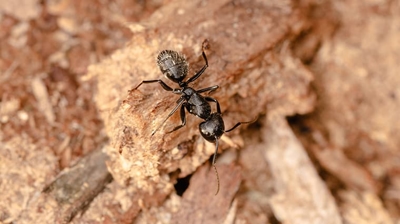
Carpenter AntCarpenter Ant (Camponotus sp.). At 5/8 inch, the black carpenter ant is the largest ant species found in the U.S. Any large black ant found in New Jersey is a carpenter ant. Carpenter ants are considered wood eating ants and can cause serious structural damage to homes and wood structures that can result in structure collapse. Primarily nocturnal, carpenter ants do not sting but have a sharp bite. They use their formidable jaws to chew huge nesting galleries into wood.

Carpenter ants typically nest outdoors in rotting stumps, logs, firewood stacks, fence posts and damaged trees, gaining access through pruning scars or broken branches. However, these ants will forage 100 yards from their nests and often invade homes in search of food and water. Carpenter ants prefer to nest in high moisture areas. In homes they will seek out wood timbers, siding and roof shingles damaged by leaking plumbing, clogged drains or overflowing gutters.

Carpenter ants can attack your home via tree branches overhanging the roof, overgrown bushes scraping again door or window frames and garden mulch that abut foundation walls. Once inside, carpenter ants build their nests inside walls, in poorly ventilated crawl spaces and attics, under insulation, in porch pillars, shingle roofs and door and window frames. Unlike other ants that are primarily found on the ground floor, carpenter ants are adept climbers and may be found crawling on walls or floors anywhere in your house.

Omnivores, carpenter ants feed on other insects and plant matter. Like other ant species, they also feed on sweets, food scraps, fruit and aphid honeydew (a sweet sticky substance produced by aphids). Unlike termites, carpenter ants do not ingest wood, but they do cause considerable structural damage as they tunnel galleries into wood to build and expand their nests. Attracted to soft, moist wood, carpenter ants will expand their galleries into sound, dry lumber as the colony grows. Unlike termite galleries that are lined with mud, carpenter ant galleries are smooth and clean. Mounds of sawdust-like debris created during tunneling are a sure sign of carpenter ants.

Top

Nuisance House Ants You May Find in Your Home

Although beneficial outdoors, nuisance ants are a persistent and annoying problem when they invade your home. Several species of nuisance ants are common to northern New Jersey. Because many ants look identical to the untrained eye, accurate identification requires the expertise of a knowledgeable pest control expert.

The acrobat ant or Valentine ant.• Acrobat ant (Crematogaster). Also called the Valentine Ant because its dark abdomen has a heart-shaped appearance when viewed from above, acrobat ants are 1/8 inch long with shiny yellow to dark brown bodies. These ants get their name from their unusual habit when disturbed of raising their abdomens into the air as if they were balancing a ball.

Acrobat ants feed primarily on a sweet substance produced by aphids called honeydew but will also eat sweets and proteins. Attracted to water-damaged wood, acrobat ants nest in decaying tree branches or stumps and often move into wood previously damaged by carpenter ants or termites.

When these ants invade homes, they are generally found living in door and window frames or foam insulation.

• Argentine Ant (Iridomyrmex humilis). Only rarely seen in New Jersey, these ants are native to Argentina. Common in the South, Argentine ants are expanding northward and are already a problem in Maryland.

Argentine AntLight to dark brown in color and 1/8 inch long, Argentine ants prefer sweets but will eat nearly anything. Highly invasive, these ants drive out native species, taking over their nests.

Super colonies grow to colossal size with many trails, quickly overwhelming local habitats. Incapable of digging deep nests, Argentine ants live in loose leaf litter, beneath gravel areas, along structural edges and in foundation cracks. They seldom nest indoors but may enter your home in search of food.

• Black Ant. When people refer to black ants they can mean any number of dark colored ant species. In New Jersey, any large black ant is a Carpenter Ant. Small black ants are likely to be Little Black Ants but may be any of several other species.

Citronella Ant• Citronella Ant (Acanthomyops interjectus). Named for the citronella-like smell they emit in defense and when crushed, these 3/8-inch ants are yellow to red-brown in color. Citronella ants are considered harmless and feed primarily on the honeydew produced by aphids and mealy bugs. They live underground but may swarm indoors in early spring. Citronella ants are often confused with termites when they swarm indoors.

• Fire Ant (Solenopsis). These dangerous, highly aggressive stinging ants are not yet evident in New Jersey, but they have been reported in Maryland and are gradually moving north.

Top

• Grease Ant. See Thief Ant.

• Little Black Ant (Monomorium minimum). Shiny, black and slow-moving, these tiny 1/16-inch ants often nest indoors in woodwork or masonry. Outdoors they nest in lawns, typically under rotting wood and other objects. They feed on almost anything humans eat, including sweets, grease, meat, fruits and vegetables, as well as aphid honeydew and other insects.

While little black ants pose no threat to humans or property, they are tiny enough to easily infiltrate food containers, contaminating contents.

Odorous AntOdorous House Ant (Tapinomia sessile). Also called Sweet Ants, odorous house ants are primarily sweet feeders, these dark brown, 1/10-inch long ants forage in large numbers, swarming kitchen counters and garbage cans in search of sweet foods and liquids and contaminating food supplies in the process.

These ants get their name from the foul rotten coconut smell they emit as a defense and when crushed. Odorous house ants exhibit trailing behavior, and you may observe long trails of these ants leading from a doorway or window into your kitchen. While these ants do not bite or sting, their massive numbers and swarming behavior make them a significant nuisance when they invade your home.

Despite their name, odorous house ants usually nest outside just under the soil surface and under stones, logs and garden mulch. When these ants come indoors, they often nest behind paneling, under carpets, beneath floors or in walls around hot water pipes and water heaters. Colonies multiply by budding in which portions of an existing colony relocate to a new nesting site, making these ants very difficult to eliminate.

Pavement Ant• Pavement Ant (Tetrasmorium caespitum). These 1/8 inch dark brown ants are most active in the spring when they are typically seen swarming over sidewalks and concrete patios. Pavement ants nest in the ground under stones and concrete structures such as building slabs, sidewalks and patios.

If your home is built on a slab, pavement ants may swarm over floors in huge numbers in the spring. Pavement ants feed on almost anything, including other insects, meats, cheese, nuts, seeds, bread and sweets.

While they pose no public health risk, their large numbers and swarming behavior can make them a considerable annoyance. They can contaminate food if they enter your home. The inaccessibility of their nests makes pavement ants a challenge to eliminate.

Top

Pharaoh AntPharaoh Ant (Moonomorium pharaonis). Also called Sugar Ants, pharaoh ants are just 1/16 inch long and a translucent golden yellow to reddish color. Their small size and translucence makes pharaoh ants difficult to see. Omnivores that exhibit trailing behavior, these ants feed primarily on sweets, soft drinks, fruit juices, corn syrup, cakes and breads, greasy and fatty foods and dead insects. Because of their tremendous numbers, pharaoh ant colonies can consume large quantities of food.

A tropical species transported to New Jersey, pharaoh ants are extremely sensitive to cold. In northern New Jersey, pharaoh ants dwell exclusively indoors in multiple large colonies with as many as 200 queens. Colonies multiply by budding in which portions of an existing colony relocate to a new nesting site, making these ants very difficult to eliminate.

Pharaoh ants are carriers of more than a dozen bacteria and pathogens including Staphylococcus, Salmonella, Pseudomonas, Clostridium and Streptococcus pyogenes. Pharaoh ants are a serious problem in many hospitals and nursing homes where they are known to spread infection. They can also be a persistent problem in nursing homes, apartments, hotels, groceries and restaurants. Pharaoh ants can chew holes in silk, rayon and rubber goods and sometimes interfere with electronics, occasionally nesting in light fixtures.

• Small Ants. People can mean any of several tiny nuisance ant species when they refer to small ants, including most of the nuisance ants described here. Little Black Ants, Pharaoh Ants, Odorous House Ants, Pavement Ants and Thief Ants may all be called Small Ants.

Top

• Stink Ant. See Odorous House Ant.

• Sugar Ant. See Pharaoh Ant.

• Sweet Ant. See Odorous House Ant.

Thief Ant (Solenopsis molesta). Also called Grease Ants, thief ants are the tiniest New Jersey ant. Just 1/20 inch long, thief ants are yellow to light brown in color and often mistaken for pharaoh ants. Thief ants feed on greasy foods, oils, meats, cheese, nuts, seeds and dead insects. They are minute enough to breach any food container and can contaminate food supplies.

Thief ants commonly nest in soil or rotting wood. Indoors they build their nests under countertops, behind baseboards and in cabinet and wall voids. Thief ants get their name from their habit of nesting near larger ants and stealing their larvae.

When You Need Professional Ant Control Services

The only way to get rid of an ant infestation is with the help of a professional pest control service with an expertise in ant elimination. The continuous supply of ants generated by multi-generational colonies can make ants difficult to exterminate. Successful colony elimination requires extermination of the entire nest, including the queen and immatures that may be hidden deep within the nest in inaccessible areas.

Disturbing the site of an ant infestation makes it more difficult to successfully treat and eliminate the colony. A Seasonal Home Protection Plan can monitor for potential ant activity, stop infestations before they grow and prevent reinfestations. If you have an ant problem, contact the ant experts at Heritage Pest Control today.

Top